Where to Find High-Paying Freelance Jobs in Web Design, AI Automation, and SEO
A practical guide to finding high-paying freelance work in web design, AI automation, and SEO—covering the best platforms, real fee comparisons, proposal strategy, pricing, and a 14-day plan to land your first client.
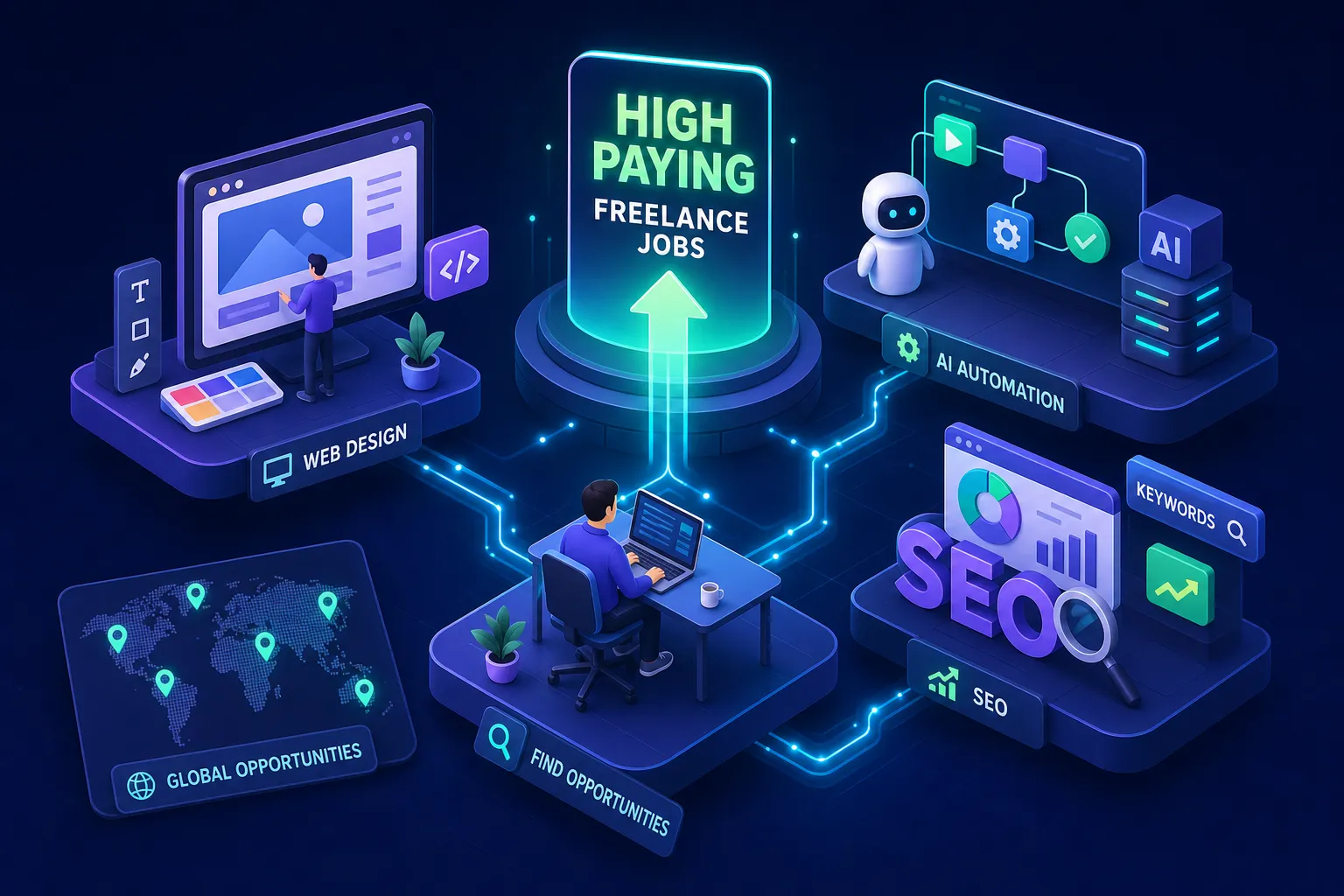
Which freelance jobs actually pay well for web design, AI, and SEO work?
Open freelance marketplaces: volume, competition, and real opportunity
Open freelance marketplaces offer the largest pool of buyers. Upwork reported 763,000 active clients in Q2 2026, while Freelancer.com's parent company reported 87.5 million registered users spanning both freelancers and clients. The buyers here are typically startups, small businesses, and agencies handling project-based work, and they're comfortable evaluating proposals themselves.
The catch is competition. On open platforms, a specific niche matters more than a long list of skills. A React developer who builds WCAG-compliant interfaces for healthcare startups will stand out over a generalist who "does web design and more." The volume is real, but so is the noise. You need a position, not just a profile.
Vetted networks and zero-commission alternatives
Vetted platforms narrow the pool but raise the floor on project quality and client seriousness. Toptal serves funded teams and enterprise buyers; Contra attracts design-forward founders and product teams. Both reward specialists over generalists. Contra's zero-commission model means every dollar you bill stays with you before payment processing, which makes it worth building a presence there even if you focus primarily elsewhere.
Freelance job boards that skip the commission game entirely
LinkedIn Jobs, FlexJobs, and Freelancermap don't take a percentage of your earnings. They connect contractors and clients directly. LinkedIn is especially effective for warm outreach: a well-placed message to a founder who already knows your work tends to convert better than a cold proposal dropped into a crowded inbox. FlexJobs curates remote contract work across traditional service categories, charging job seekers a subscription rather than a commission on completed projects.
What do platform fees actually cost you?
A plain-language comparison of what each platform takes
Fees look small in percentage terms until you run them against an actual project. A zero-commission platform on that same project costs nothing beyond payment processing. Here's how the major freelance platforms compare, based on figures reported by Colorlib, Vagon, and Upwork's own published terms (2026):
Platform | Freelancer fee | Client fee | Freelancer take-home |
Upwork | 0–15% per contract | ~5% (basic plan) | 85–100% |
Fiverr | 20% flat | 5.5% + small-order surcharge | 80% |
PeoplePerHour | 3.5–20% sliding scale | Varies by payment method | 80–96.5% |
Contra | 0% commission | Plan or product fees may apply | 100% before processing |
Toptal | No disclosed freelancer fee* | Marked-up custom rate | 100% of agreed rate |
*Toptal negotiates rates privately; the freelancer margin is not publicly disclosed.
The hidden costs that don't show in the headline percentage
The headline percentage is never the complete picture. Upwork requires Connects to submit proposals, and those cost real money at scale. Freelancer.com and Guru offer paid membership tiers that reduce per-project fees but add a recurring subscription cost. Payment processing through PayPal, card, or bank transfer layers on additional costs at every platform.
Picking the right platform for the right project matters more than minimizing fee percentages across the board. A high-value relationship built on Contra at zero commission serves a solo studio far better than a string of small gigs at 80 cents on the dollar. Think in dollars, not percentages, and choose accordingly.
How a one-person studio lands clients without a sales team
Starting with a discovery conversation, not a quote
At Sirajul Studio, every project begins with a discovery conversation before any design or code work starts. We ask about the client's target audience, goals, and content first. This approach separates a focused one-person studio from freelancers who jump straight to mockups, helping align every deliverable with the client's actual goals from day one.
The build: React, WCAG compliance, and a GPT lead-capture layer
Our engagements typically involve a React and Next.js site built with semantic HTML, schema markup, and accessible-by-default code that scores above 95 on launch. Alongside the web build, we set up custom GPT pipelines for lead capture: qualifying inbound inquiries and routing them by service type, so the client's team isn't managing the entire intake manually. The SEO foundation, including technical audits, local GMB optimization, and schema markup, is structured from day one rather than bolted on at the end.
Full code and asset ownership transfers to the client on delivery, with no vendor lock-in and no ongoing dependency on our infrastructure.
Why small business owners prefer a single point of contact
The same person who runs the discovery call at Sirajul Studio also writes the copy, builds the site, and deploys the automation. No hand-offs, no communication gaps between a designer and a developer who've never spoken. For small business owners searching for a freelancer, this is the question worth asking before hiring: not just what gets delivered, but how the process holds together from brief to launch. Continuity isn't a luxury; it's how projects stay on scope and finish on time.
How do you write a proposal that actually gets a reply?
The three-part pitch structure that works across platforms
Open with one specific observation about the client's brief or business problem. Follow with your first three steps for solving it. Close with one relevant sample and one useful question that moves the conversation forward. That's the entire structure. Don't open with "I am a web designer with X years of experience." Nobody hires the biography; they hire the person who understood their problem before anyone else in the inbox did.
How to adjust your pitch for each platform
On Upwork, send proposals early on recently posted jobs, lead with the client's stated risk or goal, and attach a fixed scope. On Fiverr, the pitch lives primarily in your gig thumbnail and three-tier package structure; the written pitch comes after a buyer messages you. On Contra, write the way you'd open a working conversation rather than a formal cover letter. On LinkedIn, outreach converts best when it follows genuine engagement with the prospect's content, not a cold message with a portfolio link attached as an afterthought.
Pricing your first few freelance gigs without underselling your work
SEO specialists command $50 to $160 per hour in 2026 (Clockify and Upwork rate data, 2026). Use an introductory package for your first three to five clients: a defined scope, a slight discount from your target rate, and a small bonus instead of a large price cut. Price toward where you want to be, not toward the bottom of the market. The bottom of the market attracts the clients who are hardest to work with and least likely to refer you.
What's the fastest path from zero to your first paid freelance job?
A 14-day execution plan that doesn't require being everywhere at once
Breaking the first two weeks into three clear phases makes the process manageable.
Setup (Days 1–7): Start by choosing one service, one niche, a pricing floor, and a starter package (Days 1–2). Then create three portfolio samples each framed around problem, process, and result (Days 3–5). Finish the week by completing one primary platform profile and publishing one or two productized offers (Days 6–7).
Outreach (Days 8–12): Send five to ten tailored proposals and reach out to ten warm prospects on LinkedIn (Days 8–10). Follow up with non-responders and revise the weakest part of your proposal, which is almost always the opening line, not the price (Days 11–12).
Review (Days 13–14 and beyond): Review reply data, narrow the niche if responses are thin, and double down on the approach generating real conversations. After your first project, document the result, request a testimonial, and rebuild the sample into a stronger case study for the next pitch.
Profile credibility before you have reviews
A niche-specific title beats a generic one at the top of any profile. "React developer for healthcare startups, WCAG-compliant builds" outperforms "web developer" every time a client searches. Your About section should describe the client problems you solve, not your personal biography. Three strong portfolio pieces with documented outcomes carry more weight than twenty generic samples with no context or results attached. Credibility on a new profile comes from specificity, not from volume.
Going deep on one platform beats spreading thin across five
The best freelance jobs aren't scattered across every marketplace simultaneously. Upwork for volume, Contra for no-commission relationships, LinkedIn for warm outreach, Fiverr for packaged services: pick the one that fits your offer, build credibility there first, and then expand when you have reviews and case studies to carry to the next platform.
A clear offer, a discovery-first process, and full client ownership of every deliverable do the work. That approach is replicable whether you're a solo designer, an AI automation specialist, or an SEO consultant. The principles hold regardless of the service category.
If you're a small business owner who's hiring, look for the freelancer who asks about your audience before asking about your budget. That's the one building something that actually works for your business. The freelance market in 2026 rewards specificity over ubiquity. If you want a single point of contact who handles web design, AI automation, and design, automation, and search work under one roof, get in touch with Sirajul Studio to find the right fit for your project.