7 Practical Principles of Design of Systems for Small Business Websites
Small business websites fail when they are built as separate pages instead of connected systems. Learn seven practical design-system principles for reusable components, cleaner data flows, accessibility, SEO, and AI automation.
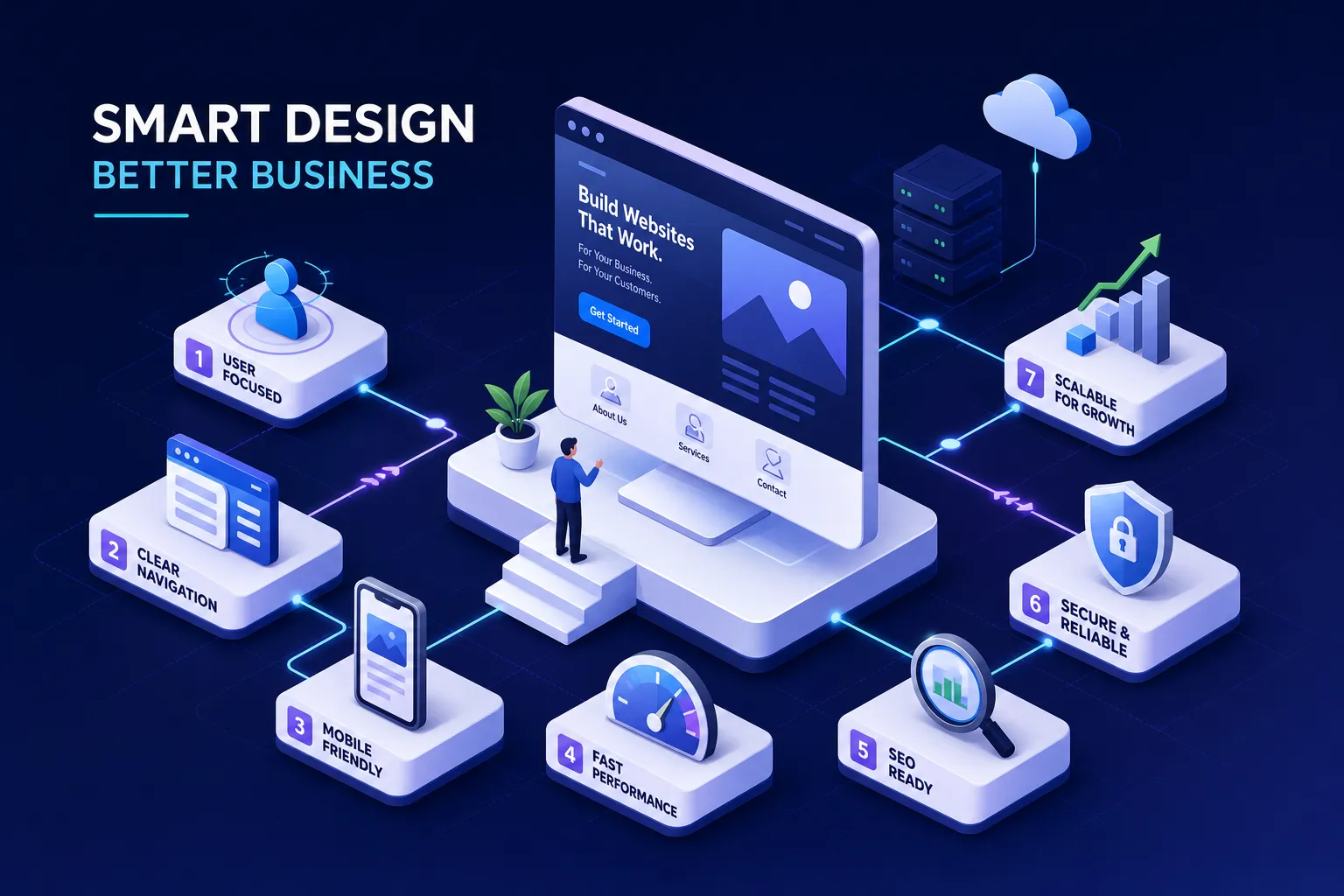
What "design of systems" actually means for a small business website
Systems thinking versus building pages
A page-based approach produces a website that works at launch. Systems-level thinking produces one that still works well after a new service offering, a content migration, or a team handoff. Component-based architecture in React and Next.js naturally supports this: a button is defined once, styled through a single design token, and reused across every page. When a brand color changes, one token value changes, not forty files.
Building a hero section here and a contact form there, without a unifying system logic, creates inconsistency across the site. The table below shows how the two approaches diverge on the criteria that matter most for a small business site.
Criterion | Page-based approach | Systems approach |
Consistency | Depends on manual discipline | Enforced by shared components and tokens |
Maintainability | Each page updated independently | One component update propagates everywhere |
Accessibility | Checked per page at the end | Built into component structure from the start |
Scalability | New pages require new design decisions | New pages assemble from existing components |
Handoff quality | Fragile and context-dependent | Documented, portable, and client-owned |
Why small businesses need this more than agencies tell them
Many agencies sell deliverables, not design systems. A small business owner can end up with a site that's difficult to maintain, audit, or hand off without losing something important. A reliable system at small-business scale means stable components, documented data flows, and predictable behavior under real conditions.
At Sirajul Studio, every project starts with a discovery conversation to understand the target audience, business model, and data requirements before any design or code work begins. That sequence isn't a formality. It's what keeps system logic from becoming an afterthought discovered at launch.
Design of systems: Principles 1, 2, and 3, Architecture, components, and data flow
Principle 1: Build with reusable components, not one-off pages
Atomic design applied simply: a button, a card, a navigation bar, each built once and reused everywhere. When a component is defined properly with design tokens backing its values, a rebrand becomes a token update rather than a site-wide search and replace. This component library approach contrasts sharply with the typical page-builder setup, where each page is assembled independently with no shared logic underneath. The difference becomes obvious the first time a client needs to update a brand color or swap a CTA across thirty pages.
Principle 2: Map your data flows before writing a line of code
What information moves through the site? Contact form submissions, lead captures, newsletter signups, product queries. Where does that data go: a CRM, an email platform, a Google Sheet, an AI pipeline? Mapping this before building prevents brittle integrations and broken handoffs that only surface under real traffic.
A concrete example: a form that feeds a GPT-based lead qualifier before routing a structured lead summary to the owner's inbox. That integration only works reliably when the data flow is planned before the form is built. Retrofit it later and you're patching gaps in a system that was never designed to carry that connection.
Principle 3: Performance as a system requirement, not an afterthought
Performance belongs in the architecture conversation. Semantic HTML, image optimization, minimal third-party scripts, and server-side rendering decisions in Next.js all affect Core Web Vitals. Our builds target a Lighthouse score above 95 at launch. That's not a vanity metric: performance directly affects both user experience and search indexability, and it's far cheaper to achieve through architectural choices than through post-launch remediation.
Are accessibility and SEO really system-level concerns?
Principle 4: Accessibility built into the structure, not layered on top
WCAG compliance starts at the component level: focus states, keyboard navigation, ARIA labels, color contrast ratios, and screen-reader-compatible markup. When these are treated as design constraints from day one and built into the component structure, they hold. When they're addressed in a final review pass, they break in ways that are expensive to fix cleanly.
An accessible contact form means properly associated labels, not placeholder-only inputs that disappear when a user starts typing. A readable navigation means correct heading hierarchy and keyboard-navigable menus, not visual polish over broken structure. WebAIM's 2025 analysis found that six issue types account for about 96% of detected homepage failures, and most of them (missing labels, low contrast, empty links, broken heading hierarchy) are architectural problems, not cosmetic ones.
Principle 5: SEO embedded in the architecture
Technical SEO is a system decision. Schema markup, semantic HTML structure, canonical tags, and crawlable data flows are defined at the architecture stage, not during launch week. Next.js server-side rendering supports indexability at the rendering layer itself. Schema markup for a local business acts as a structured data layer that tells search engines what the business is, where it operates, and what it offers.
For diverse or bilingual brands, international schema markup extends that layer to serve both local and global audiences. This kind of SEO architecture can't be retrofitted cleanly. It has to be part of the original structure.
Principle 6: How AI automation fits into a small business website system
AI agents as a functional layer, not a feature
A GPT-based lead-capture agent is a system component with defined inputs, logic, outputs, and integrations. It connects directly to the data flow mapped in Principle 2. In a service-based business context, the agent qualifies the lead by asking about project scope, budget range, and timeline before routing a structured summary to the owner's inbox. It replaces a generic contact form with a layer that does actual qualification work before anything reaches the owner's attention.
How we structure this at Sirajul Studio
The discovery conversation identifies the client's lead bottleneck. We then build a Next.js site with a GPT pipeline that integrates with the client's inbox or CRM. The client owns all the code with no vendor lock-in and no proprietary platform dependency.
Best practice for this kind of integration is to handle validation, rate limiting, and downstream CRM or email connections on the server side, keeping API keys and business logic off the client entirely. This is the full design of systems approach in operation: architecture, component structure, data flow, AI layer, and ownership all connected through deliberate design decisions rather than assembled at random after the site goes live.
Principle 7: Ownership, testing, and monitoring as system closure
What full ownership actually means for a small business owner
The client receives every line of code, every configuration file, and every AI agent prompt. Clients receive complete ownership of every line of code and digital asset delivered, with no vendor lock-in. This is a direct contrast to the typical agency model where the website lives on the agency's hosting plan and the "code" is a theme with drag-and-drop blocks the client can never fully audit or transfer.
Testing, monitoring, and what happens after launch
Testing should be a design of systems concern from the start, not a post-launch scramble. Accessibility checks, visual regression testing, and performance validation are most effective when they're planned into the build process rather than bolted on afterward. After launch, a practical monitoring setup for a small business site typically covers uptime tracking, Core Web Vitals monitoring, form submission verification, and AI agent output review. That coverage doesn't require enterprise overhead. It requires treating monitoring as a system requirement from the start, not something added when something breaks.
How Sirajul Studio builds from discovery to launch
The discovery-to-launch workflow
The sequence matters as much as the individual steps. Step one is a discovery conversation to understand the target audience, business model, data flows, and automation needs before any design or code begins. Step two is architecture planning: component structure, data flow map, SEO and schema decisions, AI integration points. Step three runs design and build in parallel, with UX wireframes and Next.js implementation moving together rather than sequentially.
Step four is an accessibility review and performance validation before handoff. Step five is full code and asset delivery with documentation. That sequence is designed to surface the typical post-launch discoveries early: missed accessibility issues, broken integrations, or an AI agent configured but never connected to anything downstream.
Design system governance: Starting the conversation
Sirajul Studio operates as a single point of contact. The same person who listens to the idea builds, writes, and launches the final product. No handoffs between departments, no disappearing project managers, no requirements losing fidelity across a chain of specialists.
Part of what makes this work is treating design system governance as a real concern from day one: documenting components, data flows, and integration logic so the site is as maintainable on day 365 as it was at launch. If a small business owner wants a website that holds together as a system rather than a collection of pages that looked good in a mockup, a discovery conversation is the right place to start. Book a discovery conversation with Sirajul Studio to talk through your project.
Every decision in a small business website, from component structure to data flow to AI integration, is a design of systems decision. These seven principles don't add complexity. They remove the hidden complexity that surfaces six months after launch, when a rebrand breaks forty pages, a form stops routing correctly, or an accessibility audit reveals that nothing was ever keyboard-navigable. Build things that hold together from the start, and they compound in value rather than accumulate debt.